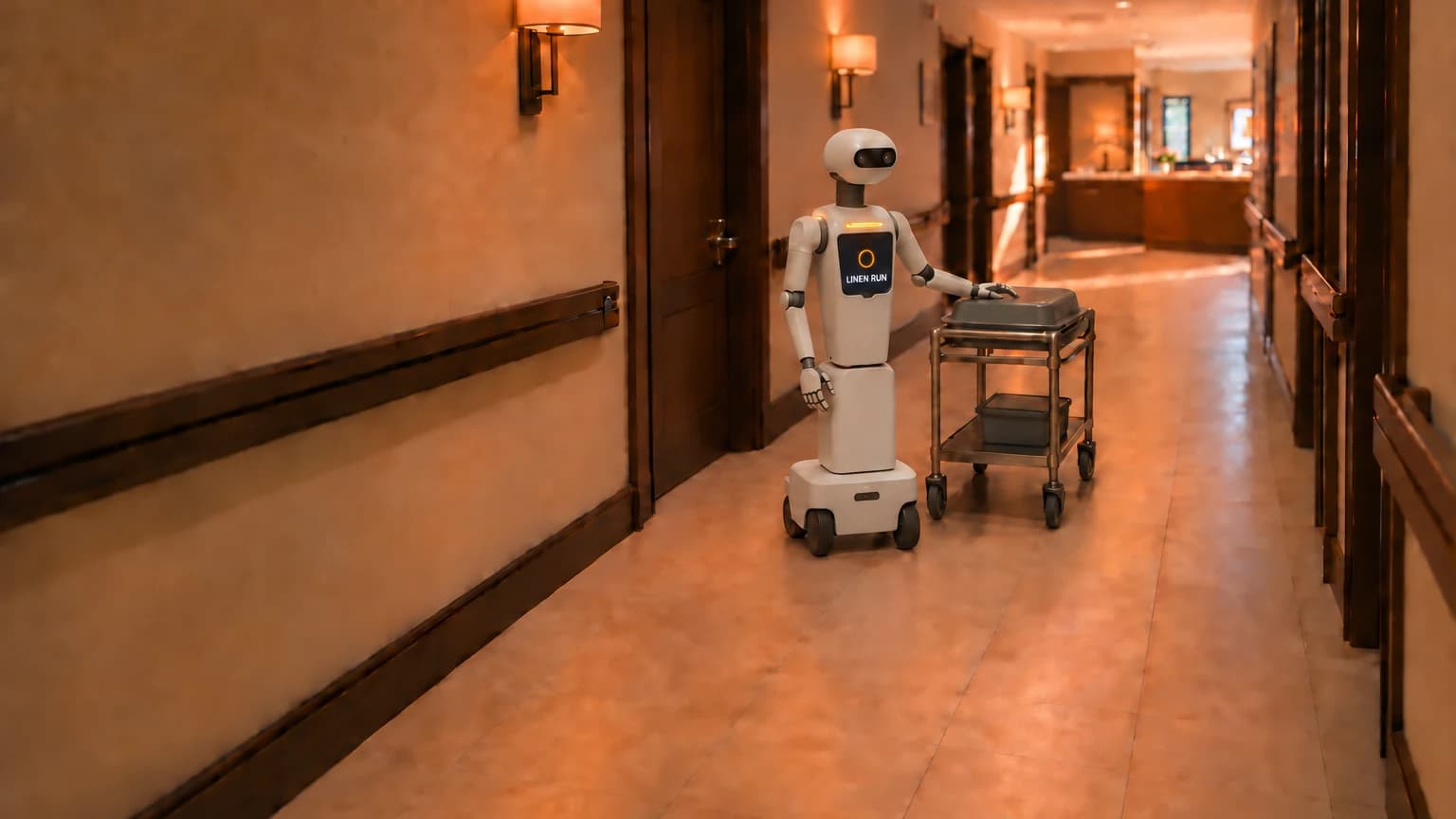
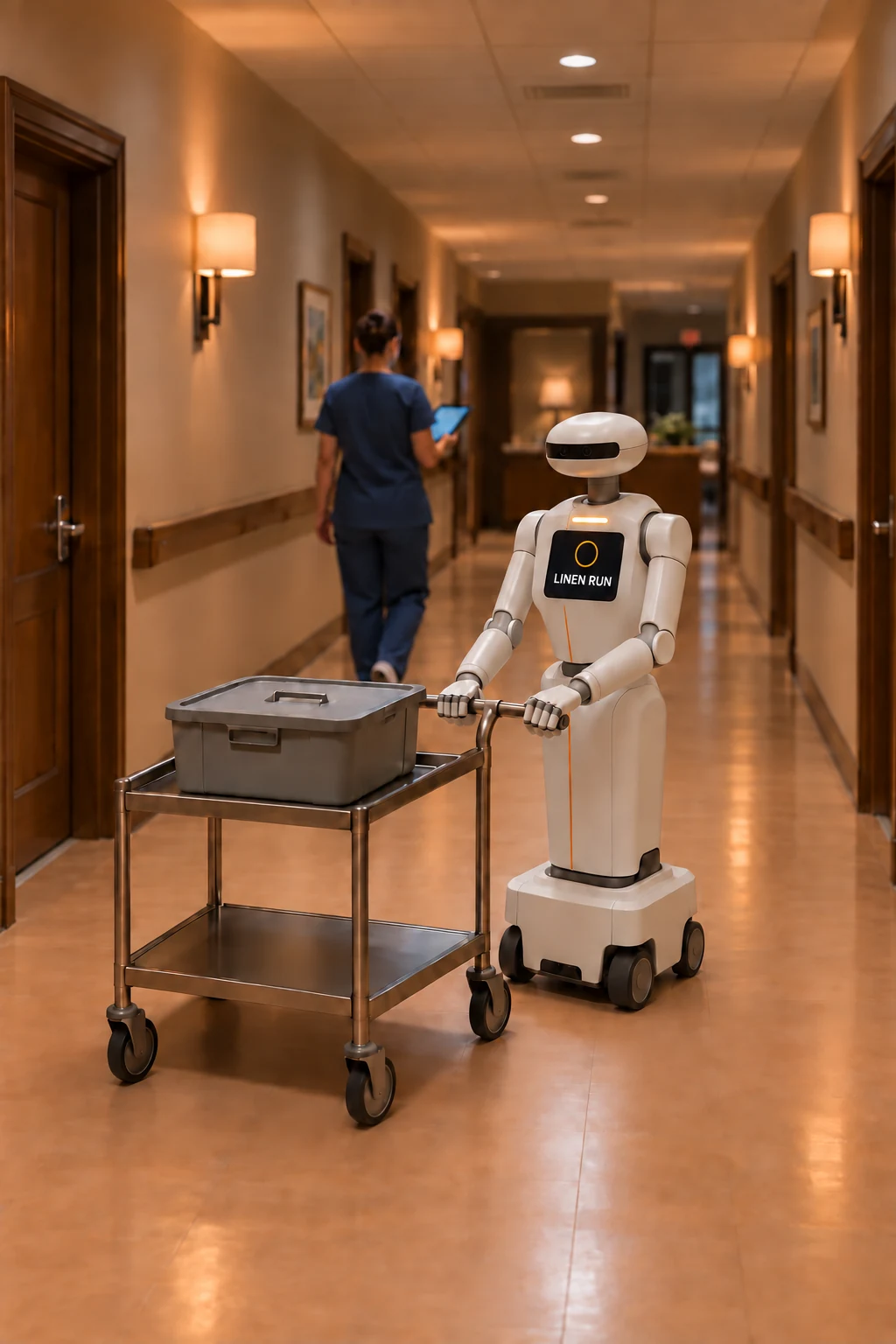
The site mind.
The intelligence that runs every robot in a critical facility. Any body. Supervised, permissioned, on the record.
The operator buys a robot to do the rounds. The mind is what they keep.
We ship Cereal robots end to end, on bodies we procure with our own compute, sensors, and safety kit, and you run them just by talking to them. Every one runs on Cereal OS, the site mind that runs, gates, and records every robot in the building, built to run the robots a site already owns, too.
The first facility funds the fleet.
Cereal is built for real places: offices, warehouses, hotels, construction sites, data centers and homes. Our first real robot runs in a home. The founding program begins with supervised sites and selected design-partner homes, each with an agreed workflow, a person responsible and a record of what happened.
Measure the work it improves.
Agree a useful workflow and measure it against the existing process. Robot, setup, support and commercial terms are scoped with each founding site before anything is charged.
The operator signs.
The site owner defines the outcome, the operating boundaries and who may request actions. The pilot must produce information the team can actually use.
Help counts before full autonomy.
Start with an operator present and supported tasks on an assessed route. Review what worked and where help was needed before expanding the scope.
The site mind is the constant. The body and its tested skills determine which work each deployment can take on.
Start with a place you know.
Different places ask different questions. Explore the workflow, the first body and what a pilot would need.
 Offices
Robots for offices.
What an office robot can do today: supervised walks of your floor with your facilities team, questions through Cole and a photo when asked. Patrols are planned. Pilots from $1,250 a month.
Explore the use case → Warehouses
Robots for warehouses.
Evaluate Cereal for warehouse inspection pilots and planned supervised rounds. Explore robot dogs, planned box and parcel transport robots, site requirements and pilot success measures.
Explore the use case → Homes
HomesRobots for homes.
Meet Cereal's robot dog for the home: talk through Cole, request a view and keep the context. See the real demo, privacy controls and founding-home program.
Explore the use case → With the optional tabletCare facilities & hospitals
Robots for care facilities & hospitals.
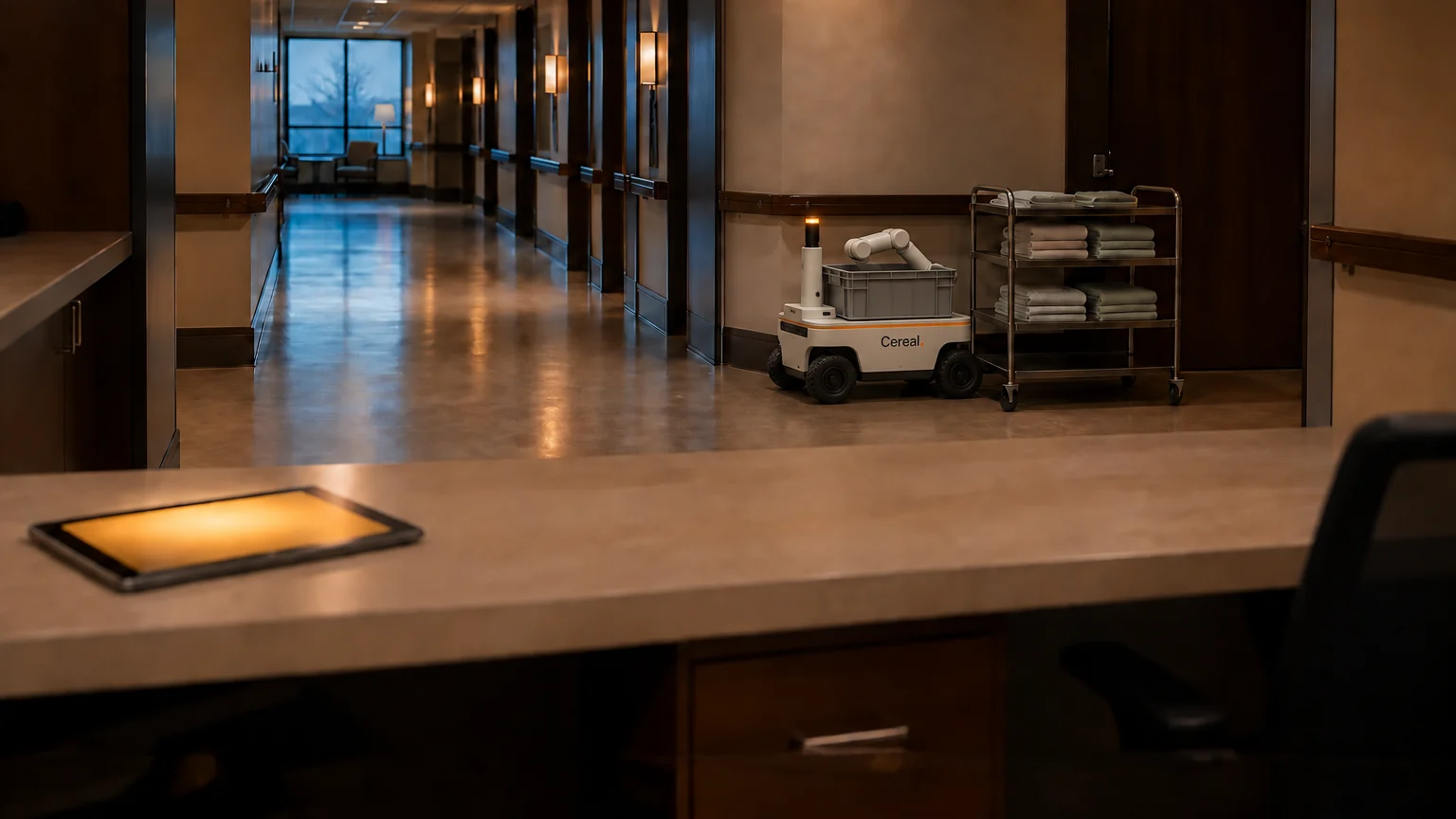
What a robot can do on a care home night shift today: supervised checks of shared corridors, with a photo when staff ask. Not resident monitoring or fall detection. Pilots from $1,250 a month.
Explore the use case → With the optional 3D mapping kitConstruction sites
Robots for construction sites.
Explore Cereal for construction sites: supervised walks at the end of the day, progress photos from the same points and visible issues flagged to the site manager. Current capabilities, site conditions and pilot measures.
Explore the use case → Campuses & venues
Robots for campuses & venues.
Explore Cereal for universities, resorts, event grounds and industrial parks: supervised route checks before and after events, questions through Cole and a clear record. See current capabilities and plan a pilot.
Explore the use case → With the optional tabletHotels
Robots for hotels.
What a hotel robot can do today: supervised night checks of guest floors and back of house, with a photo when asked. Delivery robots are planned. Pilots from $1,250 a month.
Explore the use case →Building securityRobots for building security.
After-hours building rounds with a robot: a guard or facilities person walks the route with it and gets a timed photo at each stop. Not a guard replacement; patrols on its own are planned. Pilots from $1,250 a month.
Explore the use case →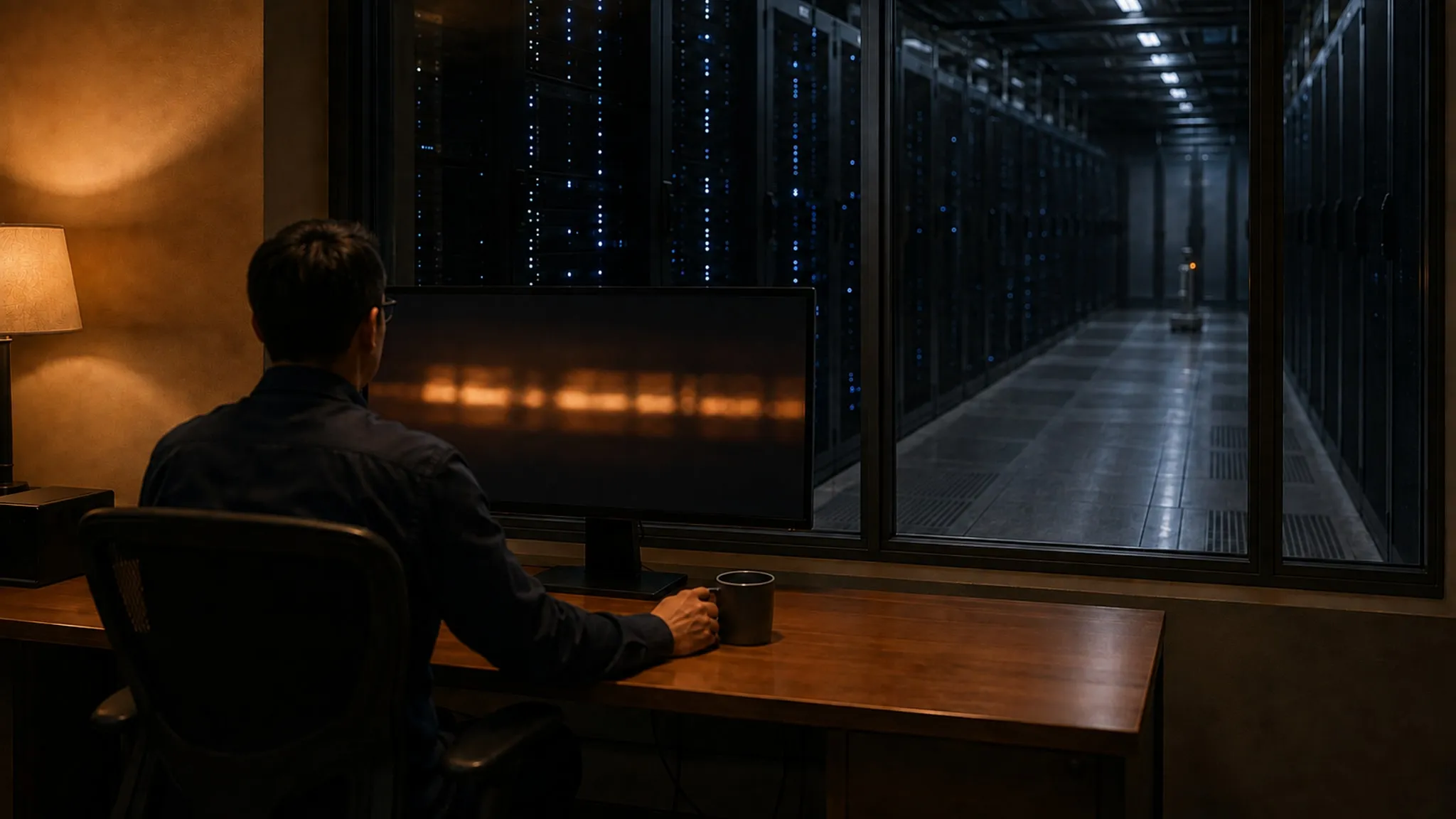
The mind already exists.
Cole is our planning and memory agent, in production with real users today. It plans, remembers, runs modular skills, and acts under human supervision. Now it runs its first robot: you call or message it in plain words, and it does what that robot supports, through Cereal OS's permission and safety checks, then tells you how it went. Only the owner can command it. Ask Cole in chat and it sends a private live view, with battery and status on screen, to the people the owner allows; the owner sees who is watching and can pause it at any time.
Cole, come to the kitchen.
On my way. I'll stop about a metre from you.
What do you see?
You at the counter, the kettle, and the back door closed.
Follow me.
Following you. Say stop any time.
Can I see what you see?
Here is your private live view. Battery 82%. Only people you allow can watch.
Most teams are still building the mind. Cereal is dropping in one that already works, built to run any body on the floor.
Explore the technologyAI is leaving the screen.
Software minds plan, reason, and advise, but stay trapped inside a screen.
An embodied mind perceives, remembers, and acts in the physical world. It doesn't just answer. It shows up.
Every robot arrives as a stranger.
Robots are getting more capable. But the intelligence stays trapped in one model, one machine, one deployment. Every new body must relearn the building: the layout, the rules, the permissions, the people. We call this the continuity gap.
Swap the robot, lose the relationship. Upgrade the model, start over. A robot without a persistent mind is a first-day employee forever: intelligence improves, and nothing accumulates.
One persistent, permissioned understanding of the site, loaded by any compliant body once it has mapped the site, including the robots already on the floor.
Robots need skills. Buildings need continuity.
The short version: one mind runs the whole building, not one body. See it move between two bodies →
We ship the whole robot. The mind is what compounds.
Billions into hardware, manufacturing, and one form factor. The intelligence comes last, welded to that body, and dies with it.
The operator signs one contract with one company for the robot, Cereal OS, service, and support. We fit our own compute, sensors, and safety kit onto bodies we procure, so the body can change and the site never starts over: identity, memory, permissions, and the record live in Cereal OS, not in the hardware.
One mind. Any body.
The world is human-shaped.
Doors, stairs, counters, shelves, handles, tools, and appliances were all built around human bodies. To operate naturally in them, a mind needs a body it can transfer into: one that can move, see, speak, reach, carry, and stand where people stand.
Human-scale bodies are the interface for a human-built world. The mind is what makes any of them useful.
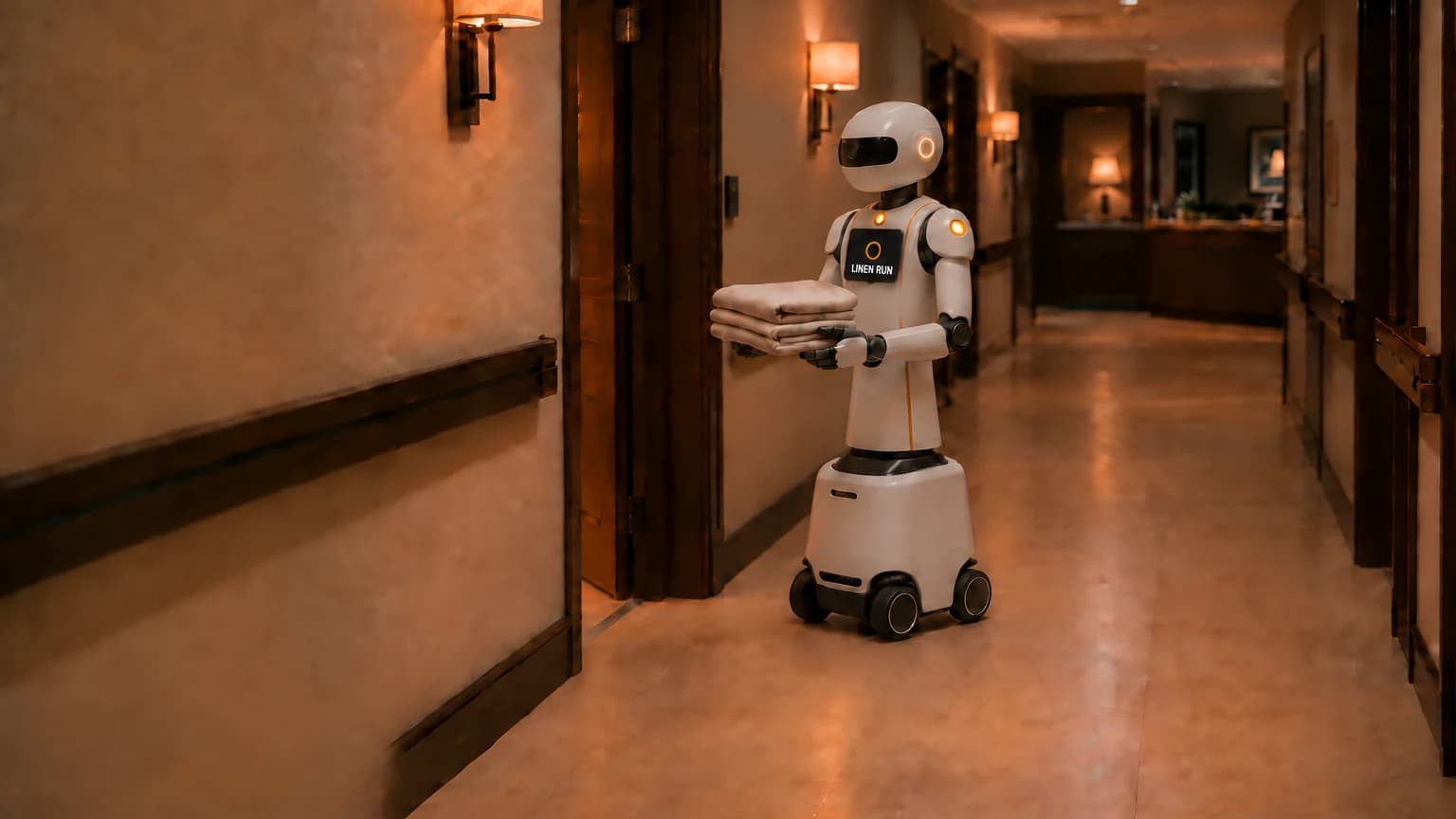
What a mind must master to act in the world.
See the world as it is.
Natural two-way conversation.
Grasp, move, and hold.
Navigate human spaces.
Remember what matters.
Improve under human control.
The scientific foundations of general embodied intelligence.
An agenda, not a victory lap. Cole is the live proof that the substrate already runs.
Embodied foundation models
Vision, language, memory, planning, and action, plus the runtime that uses and improves them.
World models
Persistent understanding of buildings, objects, people, and routines. Where Cole's memory becomes a differentiator.
Simulation science
Our training factory: procedural sites, synthetic failure, curriculum, and sim-to-real measurement.
Embodiment contract
A runtime abstraction that lets one mind transfer across arms, bases, and humanoids.
Built, formalized, and pre-committed.
Working results first, architecture second, and the evaluation protocol published before the claim.
Cereal OS on a real robot.
Our robot running Cereal OS is live in a home: it learns rooms by name, follows its owner, comes when called, takes commands only from its owner, and files a signed record of every visit. It builds on v1.1, which ran the same mind and memory across two bodies in simulation under a 49-test suite.
The Embodiment Contract.
A robot advertises what it is; a skill declares what it needs; the runtime binds or refuses safely. The portability boundary, made precise.
Persistent Embodiment Benchmark.
The evaluation we intend to win, pre-committed before the results: persistence, cross-body transfer, and intervention efficiency.
The same mind. The same shift. Any body.
One intelligence layer, running the same shift across three different bodies: transport, transport, staging.
Teach one body once. The next one already knows.
The demo that matters is not a robot doing a trick. It is the moment a second robot inherits the first one's understanding, and its rules.
Teach Body A
Tell the mobile robot which drawer the storeroom keys live in, and who on the shift may ask for them.
Introduce Body B
A fixed arm joins the floor. Different vendor, different morphology, same mind.
It already knows
Body B fetches the keys from the right drawer, honors the same permission rule, and was never taught either.
Prove it
The shared memory and the attested audit trail show exactly what transferred, and why the action was allowed.
The proof is not two robots cooperating. It is one mind persisting.
A building full of people is the hardest useful proving ground.
Unstructured, high-variance, safety-sensitive, and regulated. If a mind is useful here, it transfers anywhere.
Concept renders, not footage of a shipping product.
Transport
Next, on box and parcel transport robots: supplies, samples and parcels between approved places. The trips that eat a shift.
MobilityFloors and aisles
Planned: spills, blocked exits and trip hazards spotted on rounds and reported to a person. Today, the robot tells you what it sees when you ask.
PerceptionStaging
Later, with a humanoid on wheels and robot arms, materials staged on schedule: medication in a care site, kits in a lab, parts on a line. Every hand-off logged for audit.
PlanningRounds and presence
Planned: rounds of the rooms you choose, with a photo and a check at each stop, and a person called when something changes.
World modelEscalation
When a task trips its envelope, a trained operator steps in, disclosed by a mode light on the robot. Autonomy is earned skill by skill.
Human-in-the-loopThe record
Every action runs under a room-level permission and lands in an attested log the site can hand to a regulator.
AttestationStart useful. Learn the building. Expand without starting over.
Four jobs, each on the body built for it.
Four legs today; then box and parcel transport, delivery and butler robots, a humanoid on wheels, and finally drones and arms, each supervised from day one.
Understanding that accumulates.
Through approved interactions and corrections, the mind builds a persistent, permissioned record of the site. Every update is gated, versioned, and reversible.
More tasks. More bodies. Same mind.
New capabilities arrive as skills, and a second body, or a robot the site already runs, is designed to inherit approved site context after integration, localization and a review of its supported tasks.
One mind, any body is not an architecture diagram. It is the product journey: what the site teaches survives every upgrade.
The next assistant won't live in a chat window.
Permissioned intelligence, visible by design.
A robot on a floor full of people has to answer for itself: what it perceives, what it remembers, who controls that memory, and who may ask it to act. In Cereal those answers are product surfaces the operator and the regulator can read, not policy documents.
A wrong answer on a screen is a typo. A wrong action on a floor with people on it is an incident. That is why dependability is not a feature of the product; it is the product.
The founders already invented the hard part.
Named inventors on the foundational simulation-driven robotics patents from Google X and Everyday Robots, the exact sim-to-real approach Cereal runs on. Everyday Robots proved the problem was real. Cereal is the post-LLM restart: world models predict, the twin verifies.
ex-Google X and Everyday Robots. Author of foundational embodied-intelligence patents.
LinkedIn ↗Google X, Wing, Everyday Robots, DeepMind, Stack AV, 1X, Cruise. Named inventor on simulation and imitation-learning patents.
LinkedIn ↗Analog, Pocodot, and Cole. Granted inventor in secure interoperability and attestation.
LinkedIn ↗Former CEO, SeeChange Health · SVP, UnitedHealth · Chief of Staff, Aetna · led healthcare strategy, Fidelity Health Care Group · co-founder, HCG Secure.
LinkedIn ↗PhD Robotics, Caltech · Google X (perception lead, Everyday Robots; Tidal) · Apple · Applied Minds · Maxar · VP Software Engineering, Nauticus Robotics.
LinkedIn ↗Inventor credentials reflect prior employers · recruiting from
One mind. Any body.
Questions, answered.
What is Cereal?
Cereal builds robots that are useful in real places: homes, care homes, hotels, offices and gyms, and factories, warehouses and data centers. We ship the whole robot, on bodies we procure with our own compute, sensors and safety kit: a four-legged robot today; next, robots that carry boxes and parcels between approved places, then delivery and butler robots, then a humanoid upper body on a wheeled base, and finally drones and robot arms. You run them just by talking to them, by phone call or chat. Every one runs Cereal OS: one mind that knows the people and rooms of a site, follows its rules, hands off to a person when it should, and keeps a record of what it did.
How is Cereal different from other robotics companies?
Body makers sell a body. Model companies sell a brain. Humanoid companies weld the two together and chase full autonomy before revenue. Cereal ships the whole robot, supervised and useful from day one, on bodies we procure, and the value compounds in Cereal OS: identity, memory, permissions, and the attested record. Through Cereal Connect, certified robots from other makers will join the same site under the same rules, so swapping the hardware or the model never costs the operator the rules, the record, or the chain of custody.
What is the continuity gap?
Robots are becoming more capable, but every new robot still arrives as a stranger: intelligence stays trapped in one model, machine, or deployment, and each body must relearn the building, its rules, and its permissions. Cereal closes the continuity gap with one persistent, permissioned mind that any compliant body can load.
What can a Cereal-powered robot do?
Today, our four-legged robot follows its owner room to room and into the lift, comes when called, learns rooms by the names you give them, tells you what it sees, speaks through its own speaker, and stops itself when a safety check trips. Next come robots that carry boxes and parcels between approved places, then delivery and butler robots, then a humanoid on wheels for picking things up and handing them over, and finally drones and robot arms. These are planned, not available yet. Each robot takes only the jobs its body and tested skills support, under the site's rules, with a person a tap away, and every job is recorded.
What is Cole?
Cole is our planning and memory agent, in production with real users today. It plans, remembers, runs modular skills, and acts under human supervision. Since October 2026 it runs its first robot: you call or message it in plain words, and it does what that robot supports, through Cereal OS's permission and safety checks, then tells you how it went. Only the owner can command it, and the owner decides who may watch it live.
What happens to the memory when a site switches robots?
Keeping the context with the site is the design: identity, memory, permissions and the record should survive a hardware change. A new body still needs a supported adapter, mapping or localization and validation of the tasks it can safely perform. We have demonstrated cross-body continuity in simulation; the current physical deployment uses one quadruped.
Where do you start?
Our first real robot runs in a home. The founding program starts with supervised sites and selected design-partner homes, with applications open worldwide. Offices, warehouses, hotels and other facilities each need their own site assessment. We agree supported tasks, supervision, timing and pricing before deployment; joining the list is free.
Is Cereal safe?
Cereal is supervised from day one, with deterministic safety code beneath the mind. The AI never holds safety authority. It is useful before fully autonomous, and earns autonomy skill by skill.
What happens when the network goes down?
Local continuity is an architectural goal. The current robot connects to Cole over the internet, so losing that link interrupts connected services. The robot's local safety checks remain separate from the conversational agent. Offline capabilities and recovery must be tested for the specific deployment; do not assume that every task continues without connectivity.
Can Cereal see through the site's cameras?
No one sees through them by default. Perception sources are grants the operator makes room by room and can revoke at any time. A live view goes only to people the owner allows; the owner sees who is watching and can pause or end it, and rooms marked private keep the robot's camera off. When you ask what the robot sees, it takes a still and describes it, and the face prints it uses to recognize people stay on the robot.
Does Cereal build humanoid robots?
No. We ship Cereal robots end to end on bodies we procure, fitting our own compute, sensors, and safety kit, and we deploy and support them under one contract. Because Cereal OS is designed to be body-agnostic, a building is meant to move from a legged robot to a wheeled base or a humanoid without losing what the site has taught it. Each new body still needs its own integration and testing: one mind, any body.
What is the embodiment contract?
A runtime abstraction between mind and body. Each body publishes a capability manifest (reach, mobility, sensors, payload), and the mind scopes every task to what that body can safely do. It is how the same intelligence runs a humanoid and a bolted-down arm without retraining.
Who is behind Cereal?
The founding team helped build Everyday Robots, Google's moonshot for robots in human environments. Google pulled Everyday Robots back from market to research, then shut it down in January 2023, before it ever shipped to the world; inside Alphabet it was already doing real work. The team is regrouping at Cereal to finish the job, joined by veterans of DeepMind, Cruise, 1X, and real-time graphics.
The next AI platform lives in the building with you.
Useful. Present. Trustworthy. Every shift.
One mind. Any body.
Join the founding list